

 Our Shared Values
 Our Business
 Our Achievements
 Our Governance
 Our Leadership
 Conservation Management & Monitoring
 Climate Change
 Community Engagement
 Partnerships & Memberships
 Human Rights & Labour
 Responsible Sourcing
 Responsible Production
 Certifications
 Sustainability Report
 Palm-based Food Products
 Other Food Products
 Oleochemicals
 Bioenergy
 Seeds
Seeds Sugar
Sugar Shipping & Logistics
 Food & Nutrition Innovation
 Animal Nutrition
 Press Releases
 Stories
 Meet Our Experts
 In the News
 Publications
 Shareholder Information
 Financial Highlights, Reports & Presentations
 SGX Filings
 Analyst Coverage
 Prospective Suppliers
 Support for Palm Suppliers
 Existing Non-Palm Suppliers
 FAQ
FAQ Graduates & Professionals
 Scholarships
 Internships & Traineeships
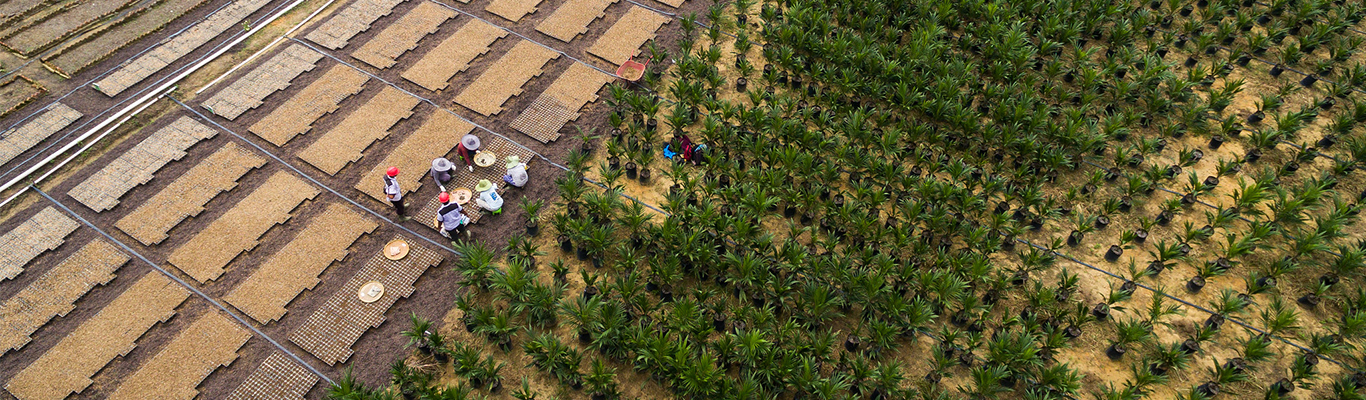
Climate change is one of the biggest challenges of our time.
At GAR, we believe bold action isn’t optional. It’s essential. That’s why we’ve created a clear, science-based roadmap to achieve net zero emissions. Our approach is grounded in innovation, practical action, and strong partnerships. We believe a sustainable, climate-smart future is possible. And agriculture, when done right, can be a big part of the solution.
Integrating sustainability into every decision

At GAR, sustainability isn’t a side project. It’s core to how we operate. From smarter land use to renewable energy, and from farmer training to green investment, we’re building a business that grows responsibly and delivers long-term value.
“We operate in one of the most climate-vulnerable sectors,” says Anita Neville, our Chief Sustainability & Communications Officer. “But that also puts us in a unique position – agriculture can be a powerful part of the climate solution.”
Climate change is already impacting agriculture, with unpredictable weather, extreme events, and supply chain disruptions. Yet agriculture also holds untapped potential for carbon reduction and ecosystem restoration. That’s why GAR has made sustainability the backbone of its operations and decisions.
With one of the world’s largest palm oil operations and over 500,000 smallholder farmers, GAR knows its scale can drive real impact. “Sustainability isn’t a trade-off. It’s how we build resilience,” Anita says. “It helps us manage risk, adapt to market needs, and secure our future.”
Over the past decade, GAR has created a comprehensive sustainability system: traceable sourcing, conservation efforts, responsible farming, and supplier engagement. This foundation is now the springboard for our journey to net zero.
Our carbon roadmap: Clear goals, real progress
Reducing emissions requires more than setting targets – it demands action, measurement, and collaboration. GAR’s carbon roadmap brings structure and transparency to this process.
“We started with understanding our full emissions profile, across all scopes,” explains Hary Kurniawan, GAR’s Head of Carbon and Renewables. “That includes our own plantations and mills, as well as emissions from suppliers, where most of the challenge lies.”
GAR’s baseline year is 2022, and from there we have set bold but realistic targets:

Reduce emissions from forest, land use and agriculture (FLAG) by 30% by 2030

Cut non-FLAG emissions – like fuel, electricity, POME, transport – by 42% by 2030

Reach net zero across all scopes by 2050
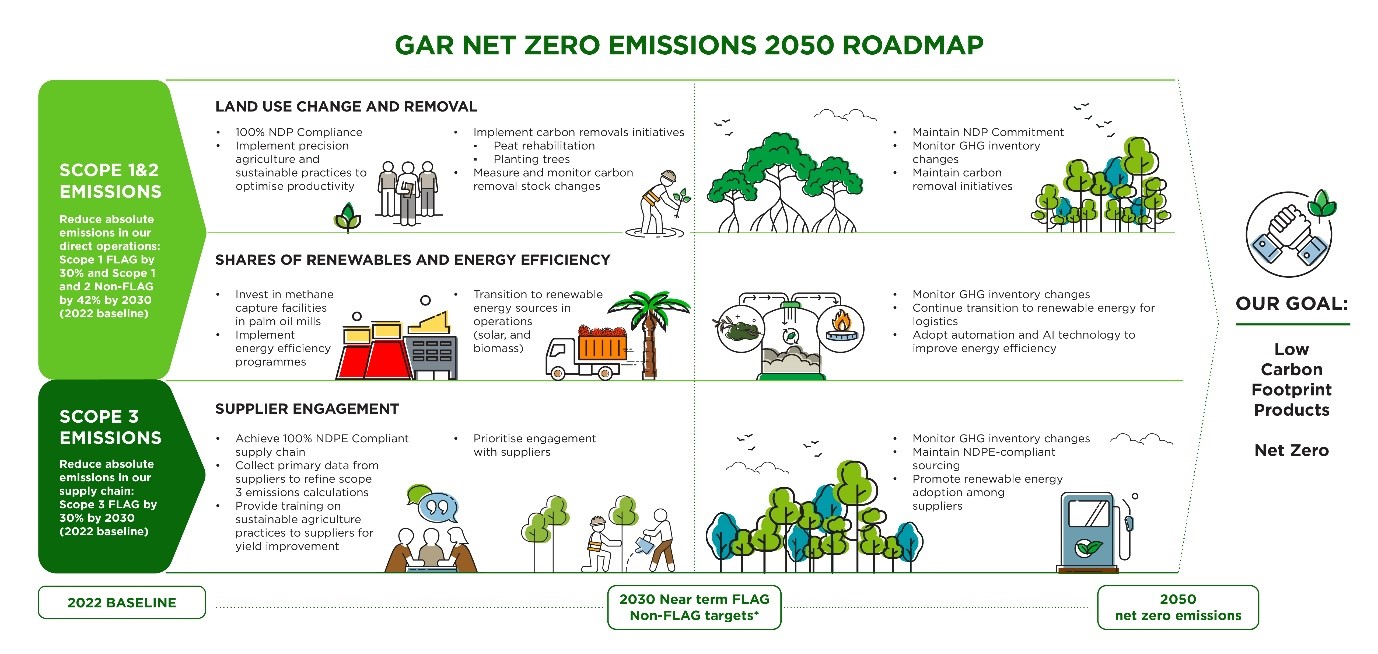

GAR’s net zero emissions roadmap at a glance
We referenced the Science-Based Targets initiative (SBTi) guidance in setting the 2030 targets. With support from Accenture and close collaboration across GAR teams, we developed a clear, time-bound Decarbonisation Roadmap.
Key progress so far:
- Scope 1 emissions (from company operations) were reduced by 7% in 2023 vs. 2022.
- This was verified by external assurance.
- The drop came from using more renewable energy, enforcing our No Deforestation and No Peat (NDP) policies, and ongoing peatland rehabilitation, crucial during the 2023 El Niño.
“This is a system-wide plan,” says Anita. “It’s not just about our operations. It shapes how we work with suppliers and where we invest.”
Where the emissions are – and what we’re doing
GAR’s decarbonisation strategy focuses on three main areas:
- Land Use and Carbon Removals
- Renewable Energy and Energy Efficiency
- Supplier Engagement
These are where most of our emissions come from and where we can make the biggest difference.
Protecting nature while improving carbon balance
Land use is one of the biggest levers for reducing emissions in agriculture. Backed by our longstanding NDPE commitment, we’re restoring balance between production and protection.
This has led to:

79,900 ha conservation area (HCV/HCS) within GAR’s concessions

Ongoing rehabilitation in peatland areas to rebuild carbon sinks and prevent peat fires

Zero land clearing on peat and full support for HCV/HCS area protection
Cutting fossil fuels, using what we have
We’re cutting fossil fuel use by harnessing what we already have – waste materials from our own production processes.
Today:

92% of GAR’s upstream energy comes from renewable sources, mainly biomass

We use by-products like palm kernel shells, expeller, fibre and rice husks to power boilers and generate steam

We’re scaling up methane capture from Palm Oil Mill Effluent (POME) to generate power and reduce emissions
Transforming the supply chain, together
Most of our emissions come from beyond our direct control – which is exactly why supplier engagement is key.
We’re working to:

Understand the emissions impacts of our suppliers

Continue sustainable sourcing from NDPE-compliant suppliers using NDPE IRF to track and verify supplier progress

Support supplier transformation through targeted carbon workshops to identify emission hotspots, and co-develop action plans
Working with – not around – farmers

One of our greatest assets is our relationship with smallholders. Through our Sawit Terampil programme, we support farmers to grow more using less land and fewer inputs, boosting incomes while lowering emissions.
“We work with over half a million smallholders in Indonesia,” says Anita. “To cut emissions from palm oil, we need to work with them, not around them.”
For smallholders, better farming practices often mean higher yields, improved land stewardship, and greater resilience to climate shocks. Sawit Terampil helps close the yield gap with training, access to improved planting materials, support for certification, and better tools.
The results? Some farmers have doubled or tripled their productivity, producing more palm oil without expanding into forests.
“When smallholders succeed, our sustainability goals move forward,” Anita adds. “Climate action has to be inclusive. We see smallholders as allies, not liabilities.”
The hard part: Who pays for it?
Sustainable agriculture takes investment. But right now, agriculture receives less than 5% of global climate finance.
“We’re being asked to decarbonise one of the most complex supply chains on Earth,” Anita points out. “But the funding simply isn’t there.”
GAR has already invested heavily. From building traceability systems, launching biogas projects, protecting forests, to helping suppliers transition to more sustainable practices. But scaling this impact, especially in Scope 3 emissions (which lie outside our direct control), will require co-investment.
GAR’s climate strategy aligns closely with the goals of many of our customers. Our work to lower emissions also helps buyers meet their own net zero commitments.
| Nature-Based Solutions | Biomass |

Carbon removal projects that also protect biodiversity, improve livelihoods, and safeguard forests. Developed under international standards to enable Payment for Ecosystem Services (PES) from carbon and biodiversity gains. |

Using palm by-products like Palm Kernel Shell (PKS) and pellets as renewable fuel, helping increase our share of renewable energy. |
| Biochar | Biogas |

Pyrolysis (heating organic waste without oxygen creates carbon-storing biochar – improving soil health and generating carbon credits for Greenhouse Gas (GHG) reductions or removals. |

Capturing methane from Palm Oil Mill Effluent (POME) to produce biogas, bio-CNG, and bio-methane. Three biogas and two bio-CNG projects are already underway in 2025 – and growing. |
The path forward: Shared responsibility
Even with a strong strategy and proven results, we know we can’t do it alone. That’s why we’re inviting partners, like customers, banks and policymakers to join us.
Whether through co-financing, purchasing carbon credits, or investing in traceable, low-emission products, real progress will take collaboration.
“GAR is proving that climate action in agriculture is possible,” says Hary. “But to go further, we need others to walk this path with us.”
From field to future – we’re growing with purpose. Explore our full Sustainability Report 2024 to see how we’re turning plans into progress across climate, communities, and conservation.